
The Sovereign Blueprint: How We Solved the B2B Data Privacy Paradox
Hector Cabrera
Founder, Sovereignware™ (U.S. Pat. App. 19/458,785 Trinary Bound™) | Sovereign AI SaaS + Ternary Hardware | HecTec.ai DMH Florida | Former Senior Programmatic Ad Operations Manager @ AI Media Group
September 9, 2026
For years, B2B marketing relied on a flawed playbook: collect personal data, route it through cloud brokers, and let third parties grade their own homework. It is a costly mistake. Gartner estimates that poor data quality and broken tracking cost organizations an average of $12.9 million every year.
Renting better cloud analytics won't fix this—taking complete ownership of your data ecosystem will. Joint research from Boston Consulting Group (BCG) and Google shows that companies using owned, first-party data capture up to 2.9x higher revenue growth and 1.5x cost-efficiency gains.
At DMH, we built an open, on-premise framework that keeps customer data inside our own four walls as a protected, owned asset. Here is how the blueprint works.
1. Account-Based Tracking Without Invasive PII
In B2B, you don't need a prospect's private browser history to close a deal—you simply need to understand the business entity's journey.
McKinsey & Company research on digital trust reveals that 87% of buyers will refuse to do business with a company if they have concerns about its security and data privacy practices.
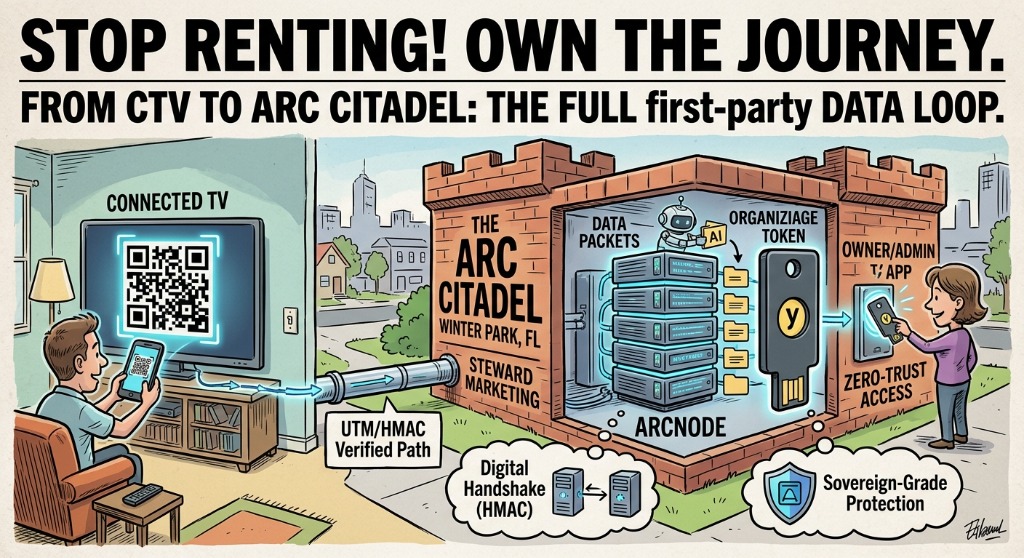
Our system solves this by automatically hashing every touchpoint into a secure digital ID. Whether a prospect reads an article or visits your site, data authenticates server-to-server. You track account-level engagement without ever holding invasive PII liability.
2. Node Zero & Ark Citadel: Hardware-Anchored Control
Instead of dumping raw customer signals into a generic cloud database, local workflows organize and load that hashed data onto ArkNode—our specialized smart hardware system hosted locally.
This is your Node Zero: an owned, physical hardware environment. It categorizes your attribution metrics, customer histories, and campaign performance locally. Because data stays anchored on dedicated hardware, your core intelligence remains insulated from cloud aggregators and third-party leaks.
3. Zero-Trust Access: The Physical YubiKey Gate
True data sovereignty requires unbreachable security at every touchpoint. To prevent credential theft or unauthorized remote access, our administrative protocols enforce a strict Zero-Trust model.
By integrating physical YubiKey security keys, access to your core intelligence requires physical hardware verification. Even if admin password credentials leak online, your master database remains unbreachable.
4. Cloud Mirroring: The Twin JSON (Node Plus-One)
To run campaigns across programmatic channels and social platforms, your system occasionally needs to communicate with the outside world. That is where our Twin JSON architecture comes in:
- Node Zero (Local): Anchors your master history, sensitive client relationships, and core logic on physical hardware.
- Node Plus-One (Cloud): Acts as a secure, lightweight mirror that communicates with external networks and ad publishers without exposing your primary database.
Let's Build a Better Standard
Growth data isn't disposable campaign fuel you rent from cloud platforms—it is a core business asset. By combining automatic hashing, hardware-anchored storage, and physical security keys, you eliminate privacy liabilities and truly own your client relationships end-to-end.
We engineered this framework in-house (U.S. Patent Application No. 63/941,720) and are actively looking to collaborate with technical peers, marketers, and security leads.
How is your team handling local data sovereignty and on-premise infrastructure? Let’s connect.
References & Sources
- Gartner: Financial impact of poor data quality and broken tracking ($12.9M annual average loss per enterprise).
- Boston Consulting Group (BCG) & Google: First-party data maturity research (2.9x revenue lift and 1.5x cost-efficiency multipliers).
- McKinsey & Company: B2B buyer trust, security, and digital privacy expectations (87% non-transaction threshold).
Notice: The sovereign architecture and system frameworks detailed in this publication are patent-pending (U.S. Patent Application No. 63/941,720).