
We Aren't Buying Our Customers. We're Earning Them.
Sovereignware™ Doctrine // Founder's Note
I spent almost a decade strategizing and operating large brands inside the ad-tech world. I respect the people there — that's where I learned my craft. But I've seen where the dollars actually go, and here's why my company is choosing to spend them differently.
For a bootstrapped B2B startup, copying the enterprise ad-tech playbook isn't just inefficient — it's financial quicksand. So we're not going to do it.
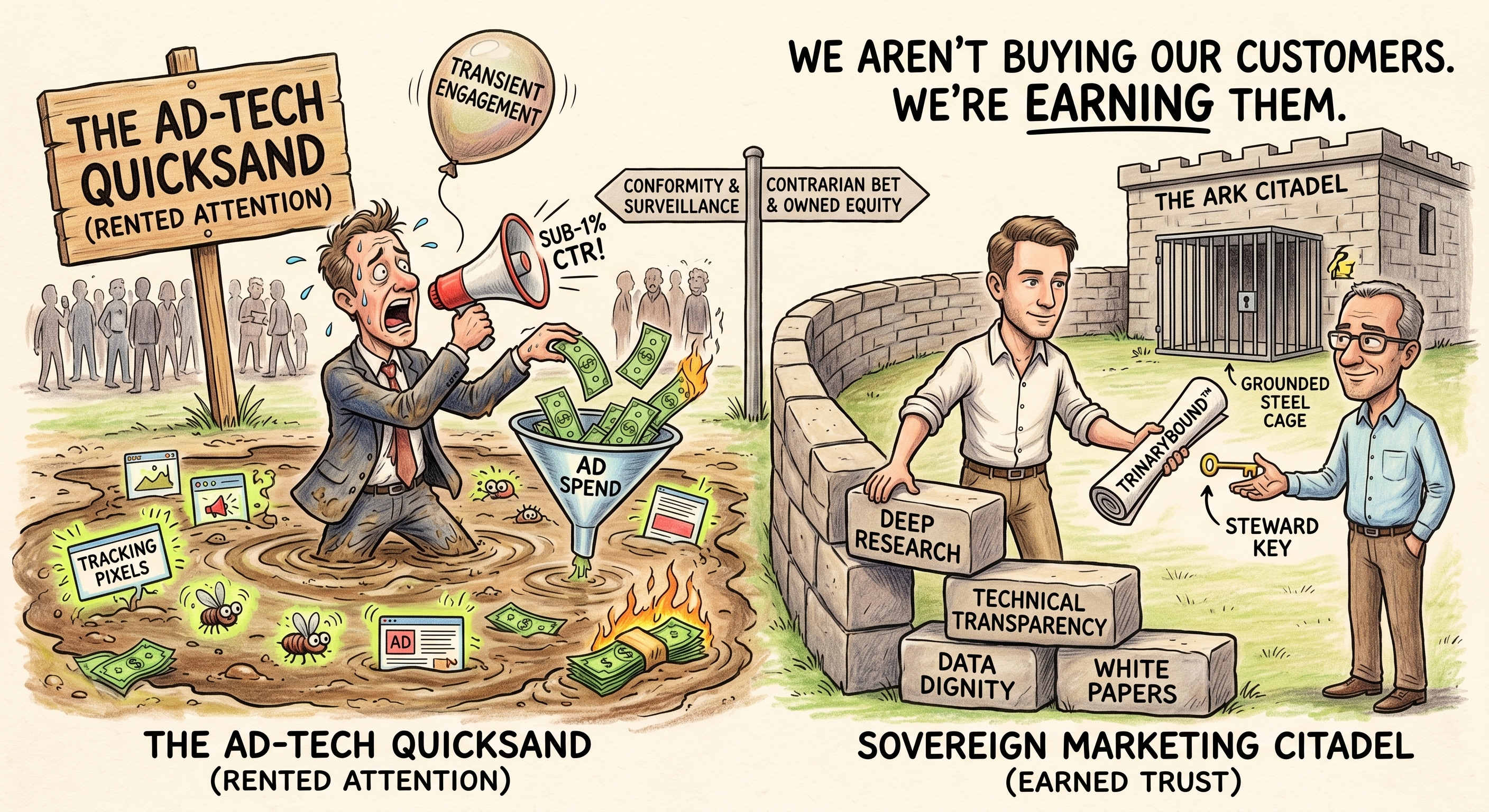
Instead of renting transient attention from ad networks that surveil prospective buyers, HecTec is committing to a different discipline we call Sovereign Marketing. The thesis is simple: in a market exhausted by surveillance capitalism, the most durable marketing moat isn't a tracking pixel. It's an un-copyable foundation of deep research, technical transparency, and absolute data dignity.
Here's the reasoning — and the evidence — behind that bet.
The Math Against Rented Attention
Engagement has collapsed. Google Ads benchmark data puts the average display-ad click-through rate at just 0.46% — and broader display studies report standard banner CTRs as low as 0.05–0.1% (WordStream/LocaliQ; Smart Insights). Out of 10,000 cold impressions, an advertiser is paying to chase a few dozen clicks at best — a meaningful share of them bots or accidental taps.
The intermediary tax is real and audited. The landmark ISBA/PwC Programmatic Supply Chain Transparency Study found only 51% of advertiser spend reached publishers, with 15% — the "unknown delta" — completely unattributable. Even after industry reforms, the 2023 follow-up found just 65% reaching publishers. A third of every programmatic dollar, gone to the middle.
Fraud drains the rest. Juniper Research estimates ad fraud consumed roughly $84 billion in 2023 — about 22% of all digital ad spend — projected to reach $172 billion by 2028.
And beneath all three numbers sits the structural flaw: rented attention has no equity. The moment the spend stops, the presence stops — engagement falls off a cliff the same day the budget does. That's the quicksand effect: the more you pay, the deeper the dependence. Published research, by contrast, compounds — a whitepaper keeps working for you at 2 a.m. three years from now, at zero marginal cost.
A founder can rent that machine, or build something owned. We're building.
The Creep Factor: Surveillance Erodes Enterprise Trust
When your buyers are managing partners at law firms, compliance officers, and wealth managers, cross-site tracking actively works against you.
Gartner's buyer survey (published June 2025) found 73% of B2B buyers actively avoid suppliers who send irrelevant outreach. Harvard Business School research on personalized ads ("Ads That Don't Overstep," HBR 2018) found that when people learn their data was obtained in ways they didn't sanction, purchase interest measurably drops. The feeling of being watched doesn't build credibility; it erodes it.
And users aren't just annoyed — they're leaving. Cisco's Consumer Privacy Survey (2024) found 75% of consumers won't buy from organizations they don't trust with their data, and 51% of "Privacy Actives" have already switched companies over data practices. The market is migrating toward privacy-aware alternatives on its own; the only question is whether your company is the destination or the departure point.
For a sovereign infrastructure company, the cognitive dissonance would be lethal. The marketing has to be built the way the product is built — or the product's promise isn't credible.
What We Publish Instead: Verifiable Engineering
Sovereign Marketing replaces algorithmic growth hacks with intellectual equity that can be independently checked. Our engineering is published openly in the Sovereignware™ Trinary Bound™ whitepaper — architecture a skeptical CTO can interrogate:
- The White Stone Protocol (pending U.S. Patent Application No. 19/458,785) models data processing as transitions through logical states corresponding to physical states of matter. Volatile digital trails are destroyed by design; immutable records commit to a dark local storage vault — the Ark Node — that never touches a cloud.
- The Ark Citadel encloses its stateless, RAM-only compute engine inside a grounded steel Faraday enclosure, with micro-mesh shielding engineered to attenuate frequencies up to 10 GHz — security anchored in physics, not policy documents.
When you deliver unvarnished technical rigor, you don't need to track anyone.
THE RENTED MARKETING LOOP (Trend-Following)
[Capital] → [Ad Networks] → [Sub-1% CTR] → [Capital Depletion]THE SOVEREIGN MARKETING MOAT (Contrarian)
[Deep Research] → [Un-Tracked Assets] → [Dark Social Share] → [Permanent Trust Equity]
Where Enterprise Decisions Actually Happen: Dark Social and Steward Keys
Corporate buying groups don't click display links — they circulate technical specs in private channels. "Dark social" (Alexis Madrigal, The Atlantic, 2012) describes sharing through encrypted messaging, email, and internal channels no analytics suite can see; industry analyses estimate 70–84% of all content sharing now happens there. And Gartner's most recent sales survey (March 2026) found 67% of B2B buyers prefer an entirely rep-free experience.
Sovereign Marketing is built for that reality. We distribute high-value, un-tracked content — and Steward Keys: secure credentials prospective clients willingly request to unlock technical briefs and prototype evaluations. The buyer opts in. Nothing watches them. That's the whole point.
How We Measure Without Watching: The Handshake Model
If you refuse to track, how do you know anything is working? Our answer is built on the same architecture as our product.
The heartbeat, not the cookie. Our analytics layer, Site Pulse, reads only our own heartbeat — traffic in, traffic out, pages served. Server-side observation of our infrastructure, not client-side surveillance of your device. No pixels riding along after you leave. Nothing follows you home.
Handshakes, not shadows. We count only the signals people consciously hand us — a like, a comment, a Steward Key request, a return visit. If someone reads our whitepaper, researches us privately for three weeks, and comes back — wonderful. Where they went in between is none of our business.
Self-reported attribution as the gold standard. When someone becomes a client, we ask the one question ad-tech spent twenty years engineering around: "How did you hear about us?" In a dark-social world, the volunteered answer is frequently MORE accurate than the pixel — and every signal we count exists in our own logs, auditable end to end. No probabilistic modeling. No black box.
If the content isn't strong enough to make someone come back on their own, the answer isn't better tracking. It's better content.
The Bet
To be clear: this is OUR choice, not a condition of ownership. Clients who deploy Sovereignware run their own marketing however they choose — that's what sovereignty means, and it would be a strange brand of freedom that came with a mandatory philosophy attached. We simply believe a company selling data dignity should be its first reference customer.
We're betting you don't need to spy on a market to lead it — and that in security infrastructure, how you find your customers is the first proof of how you'll treat their data.
We're bringing physical parameters back to digital security. The marketing now matches the machine.
—
If you've operated inside the ad-tech machine like I did: what would it take for your company to walk away from it? I read every comment.
Request a Steward Key and the Sovereignware™ technical brief at hectec.ai. Independent privacy and sovereignty ratings: HecTec Labs.
#SovereignwareReport #Sovereignware #SovereignComputing #DataSovereignty #PrivacyFirst #OnPremAI #B2BMarketing
Sources
- WordStream/LocaliQ Google Ads Benchmarks
- Smart Insights, Ad CTR benchmarks
- ISBA/PwC Programmatic Supply Chain Transparency Study (2020)
- ISBA/PwC Study II (2023)
- Juniper Research, ad fraud $84B (2023) → $172B (2028)
- Gartner, 73% avoid irrelevant outreach (June 2025)
- Gartner, 67% prefer rep-free (March 2026)
- John, Kim & Barasz, "Ads That Don't Overstep," Harvard Business Review (2018)
- Madrigal, "Dark Social," The Atlantic (2012)
- Cisco Consumer Privacy Survey (2024)
- Cisco Consumer Privacy Survey (2022)